Showing posts with label Crackle Paint. Show all posts

Saturday, 15 December 2018

Mystery Project Revealed–Part 1–Preparation

I can now take the wraps off my mystery project. I made three little hanging heart ornaments for friends, one of whom has not yet received hers, but since she doesn’t visit my blog, I thought it was safe to reveal all!

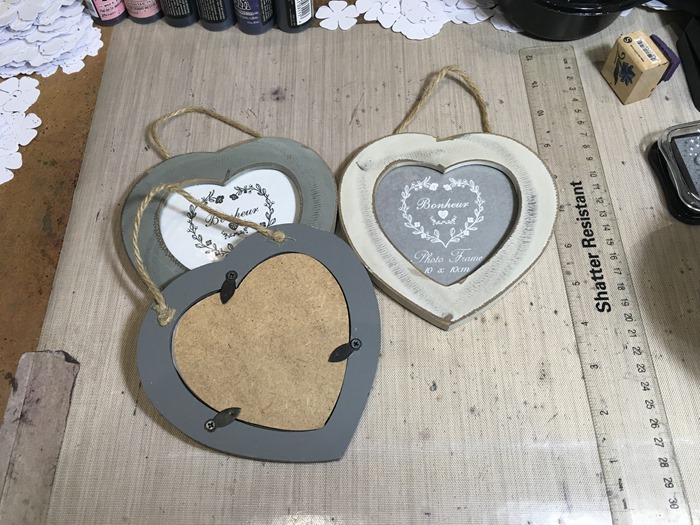
One friend asked me some time ago if I would make her a hanging heart ornament for her bedroom wall, and I couldn’t find the sort of papier mache or MDF heart that I wanted, with a hollow centre. Eventually I managed to find a set of three little heart-shaped photo frames on Ebay and decided to get these, and alter them, and it worked really well, particularly as I had two spare ones to make up for two other friends. I began with these two, as they were more urgent – we were planning to meet up for lunch but it has had to be postponed until after Christmas.

The three little heart frames as they arrived.

01 Three Small Heart Frames from Ebay

I took them apart and saved the glass and the back pieces for potential use in projects in the future, as I only wanted the hearts themselves.

02 Heart Frames Disassembled

The next step was to paint the frames with gesso.

03 Heart Frames Painted with Gesso

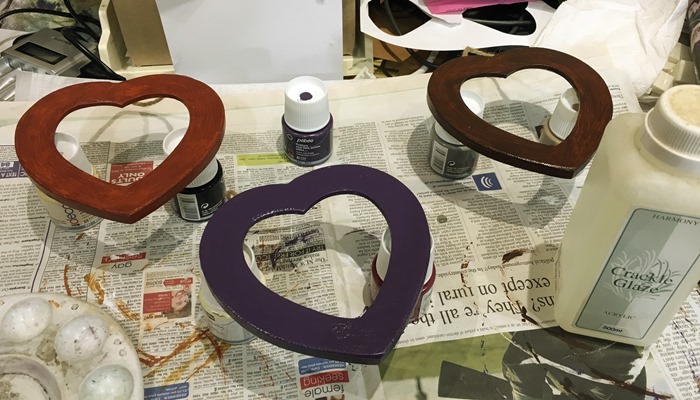
After this I painted them with a base coat in acrylic, and added some crackle glaze.

04 Heart Frames with Base Coat and Crackle Glaze

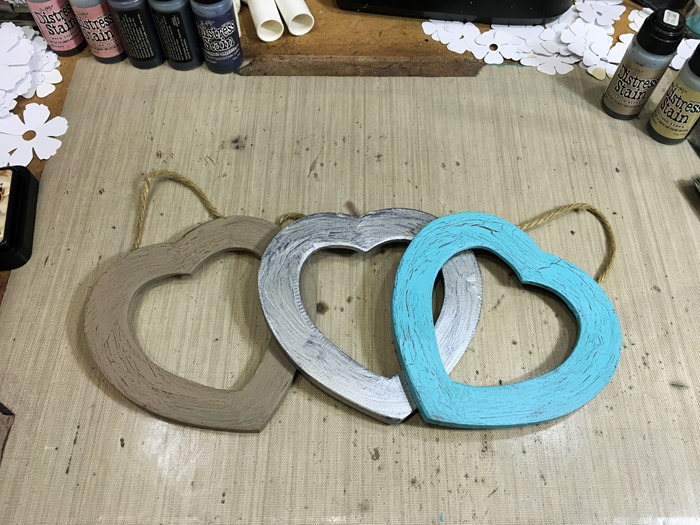
The frames with the top coat applied.

05 Heart Frames with Top Coat

The brown and turquoise ones crackled fairly well, but the silver one did not – I didn’t really mind, though, because on that one the majority of the surface would be covered with roses anyway, and I quite liked the streaked effect of the purple paint showing through the silver.

As seen on previous posts (please scroll further down for details) I made a selection of paper flowers to embellish the three frames.

42 Three Tubs of Flowers

I also made a selection of leaves.

46 All the Leaves Complete

49 Green Leaves and Tiny Purple Flowers

I didn’t use all of the flowers and leaves, and reserved the rest for other projects.

I was now ready to begin with the first of the three hearts.

Tuesday, 28 March 2017

Infusions Mini-Album–Finishing Recent Samples, and More Stamping

After the last session there were a couple of samples that needed further work. I had left the samples under heavy books overnight and for most of today and they are more or less flat now, although the one with the gesso texture still has a tendency to curl.

Looking at the weathered woodgrain sample with the crackle paste on it, I was delighted to find that where the paste was thicker, cracks had indeed appeared against my expectations. As it says on the crackle paste pot, this finish is fairly fragile so I handled it carefully. I applied the same infusions onto the sample again – Sunset Beach, Golden Sands and Black Knight – as before, creating a puddle on my non-stick craft sheet and using a fan brush to create horizontal brush-strokes, going over the top of the crackle paste. The Infusions settled into the cracks, showing them up nicely.

Once it was dry, I painted on a thin coating of soft matte gel medium to stabilise and strengthen the surface. Golden recommends that some sort of top coat is applied to protect it.

Looking at the gesso texture sample, I was pleased with how it had turned out, but decided it needed something extra, so I applied a very light touch of gold gilding wax over the raised parts. This is a lot more shiny and gold than shows in this photo.

Here’s a detail shot which shows the gold a bit better.

These are the recent samples I made, now all completed.

A while ago I noted down a couple of techniques I’d seen online, and decided to try them. The first was to stamp with Versamark or other embossing ink, and then to apply Infusions, stippling them on with a dry brush, and tapping off the excess. After this, the sample was lightly misted with water, taking care not to saturate the sample.

I used Olive Tree from set 2, and the stamp was from StampAttack’s “Real Leaves” set.

I was quite pleased with this result.

I did another one, using a ginkgo leaf stamp from the same set, and Emerald Isle Infusions from set 2, but the result was very unsatisfactory because the colour was too light. This technique obviously works best with the darker coloured Infusions – you can see from the above sample how subtle the result is. Also, I think stamps without too much detail work best. I am not sure this is a technique I shall use very often.

The other technique I found was to apply Versamark with a piece of Cut-n-Dry foam through a stencil, but I didn’t have any success with this so abandoned the attempt.

I think I’ve more or less explored all the different ways of using Infusions, apart from mixing them with paint/gesso/gel mediums – I’ll have a play with these and see what happens!

Monday, 27 March 2017

Infusions Mini-Album–Texture Samples Dried, and Stamping

The pieces I made with different textures are now dry, and it’s interesting to see the results.

First of all, the sample with the thick layer of gesso.

I added Lemoncello Infusions to the piece once the gesso was dry, and spritzed it with plenty of water so I could move the Infusions around. I propped up the piece so that the Infusions would pool in the texture. Unfortunately the gesso has badly warped the card so I had to hold it in order to photograph it adequately. Time for the heavy books treatment again.

The sample with the piece of fruit net, duly dried and trimmed.

The glass bead gel medium sample.

The gel medium has dried crystal clear, showing the glass beads to their best advantage. Here’s a detail shot of the piece.

I tried to photograph this to show how the glass beads catch the light, but as usual, anything sparkly or reflective really doesn’t photograph well.

The other pieces didn’t look that different once dried.

Last night I had some fun doing some stamping on Infusions. The Inkylicious clear stamps that I’d ordered had arrived, so I primed them ready for use. The set I used for this project is called “Create a Collage – Meadow” made up of several different stamps that you can mix and match together to produce any selection of wild grasses.

For all the stamped samples I used black archival ink.

For the one using these wild grasses stamps, I created a background using The Sage from Infusions set 1. I really like how this one has turned out.

For the next one, I was really keen to try Ryn’s stamp “Textures – Water Droplets CM-T3” with Infusions. The background was created with In the Navy from Infusions set 2.

I used a wet brush to lift as much colour as I could from inside each water droplet. This proved to be not as easy as when you use the technique with distress inks, but after several applications with the wet brush, I achieved the desired result. Removing the colour in this way makes this extraordinary stamp look even more 3-dimensional, an effect which is further enhanced by the addition of a tiny catchlight on each droplet, using a white Uniball Signo marker pen. I love how this one turned out!

My final stamped piece was created with Heartfelt Creations “Botanical Rose” stamp. This was done on a background made with Frankly Scarlet Infusions from set 2.

Again, I lifted the colour from within the flower outlines using a wet brush. I deliberately left several flowers in this state to show how effective this is. To colour the two large flowers, I used watercolours, and added a little highlight on the centre of each one, using my white Uniball Signo pen again.

Here are the completed stamped samples all together, with the gesso piece at the rear.

The next technique I wanted to do was the woodgrain effect. I think it might have been the card I’ve been using, but this wasn’t as effective as the first time I used it. Here is the page from my Mamhead Mini-Album which shows it best.

With the current samples I struggled to get the desired effect although I used exactly the same method – tapping some Golden Sands Infusions from set 1 onto my non-stick craft sheet and adding a little water, and then applying this with a fan brush in parallel strokes.

This is the finished piece after three applications of the Golden Sands Infusions.

I tried another sample, this time using Sunset Beach  and Golden Sands Infusions, both from set 1. After this was dry, because it didn’t look right, I added some Black Knight Infusions, also from set 1, using the same brushing on technique. It looked like weathered painted wood. I decided to try to enhance the effect with some crackle paste. This is the first time I’ve used this, and I thought it would dry clear, but it didn’t, and it doesn’t seem to have crackled either, but the effect is somewhat interesting.

In an attempt to make it crackle, I added some more to give a thicker layer.

Here are the two samples together.

On the pot it says it takes quite a while to crack, so maybe something will happen! If not, at least I’ve tried and after all, a lot of these samples are experimental and it doesn’t matter if they don’t work; they just won’t find a place in the mini-album.

My final samples today used the same brush-on technique, but using both horizontal and vertical brush strokes to create a mock tartan effect. Again, the effect wasn’t a dramatic as I’d hoped, and I put this down to the card I was using. I must try and remember what sort of card I used for the Mamhead album and try it with that, but in the meantime here are my samples.

The first one was done with two shades of Infusions from set 1, Sunset Beach going on horizontally, and Royal blood going on vertically. The latter had the effect of dramatically darkening the whole sample – quite an interesting effect but not entirely what I wanted!

The second one was done with Are You Cerise Infusions from set 1 being laid down horizontally first, and then Violet Storms from set one going vertically. This over-dominated the piece so I added more Are You Cerise vertically, and some more Violet Storms horizontally. The effect is definitely tartan-like, if a bit subtle!

Here are both samples together.

I do like the vertical blue stripe and the horizontal turquoise one in the one on the left.

I would like to redo all these last brushed-on samples on different card to see if the brush strokes appear more defined.

Still to come: I want to experiment a bit with embossing ink with Infusions, as I have seen some interesting videos on Youtube about this, either stamping, or using Versamark through a stencil.

Thursday, 23 October 2014

Autumn Thank You Card

The second of two posts today.

Warning – long post, picture-rich.

A card for the teacher of our felt-making class. She has been so wonderful over the past few weeks – just the right balance of demonstration and instruction, and letting us get on, encouragement and inspiration. As this five-week course came to an end I suggested to the others that I make a card for us all to sign, which would be given to her at the end of the final session last night.

Since the theme of this course was loosely an autumn theme (although we have proved that anything goes!) I thought I would make an autumn card.

Using a palette knife, I applied a thin layer of Polyfilla One Fill (known as joint compound in the USA) through my large leaf stencil onto an A4 sheet I’d created from my backgrounds folder.

03 Polyfilla Through Leaf Stencil

As this was only a thin layer, it didn’t take long to dry, with the help of my heat tool. I then added some Forest Moss distress ink, using an Inkylicious Ink Duster.

04 Forest Moss Distress Ink

Then I applied the Polyfilla through my bricks stencil, this time applying a much thicker layer, fading out the edges.

06 Polyfilla Through Bricks Stencil

I trimmed the card down to size to fit on an A4 folded to A5 card base, and used the stamp set “Real Leaves” from StampAttack to add some leaves to the blank piece.

08 Stamped Leaves

I used the Tim Holtz Dot Fade stencil to apply some Antiqued Bronze Distress Stain over the leaves.

10 Antiqued Bronze Distress Stain Through Dot Fade Stencil

After this I applied some Clear Rock Candy Distress Crackle Paint – I have had this for ages and it had got distinctly gloopy! I tried adding some water to thin it down, and gave it a good shake, and hopefully that will do the trick. These products really should have a “use by” date on them, because we all assume they last forever, and they certainly do not. No cracks appeared; only a rather rough, textured shiny surface which I quite liked.

11 Clear Rock Candy Distress Crackle Paint

After drying with my heat tool, I added some Walnut Stain distress ink using one of my home-made ink blending tools (a piece of Cut ’n Dry foam stuck onto an old wood block left when I unmounted some stamps).

I decided the leaves needed something extra so I added some Crackle Accents but this was not a success – I forgot that you are supposed to leave this to dry naturally at least until the cracks start to appear, and I launched straight in with my heat tool because I’m too impatient to wait! So no cracks from either product! Never mind, they look nice and shiny at least! I added some Walnut Stain distress ink to darken them a bit.

Time to cut them out. I rather enjoy fussy cutting and find it quite relaxing.

17 Fussy Cut Leaves

Once the Polyfilla through the brick stencil had dried, I coloured it with a mixture of distress stains and distress inks, and used both blending tools and Inkylicious Ink Dusters, using Spiced Marmalade, Rusty Hinge, Brushed Corduroy and finally some Vintage Photo. Using the Ink Duster enabled me to colour the sides of the bricks.

15 Inking Moulding Paste with Vintage Photo

To emphasise the bricks, I painted between them with Black Soot distress ink, swiping the ink pad over my craft sheet and picking it up with a wet brush.

16 Painting Between Bricks with Black Soot

I attached the leaves with hot glue, which proved not to be ideal because one of the leaves popped off just before we gave the card to the teacher. Pinflair would have been better.

18 Fussy Cut Leaves Applied with Hot Glue

At this point I distressed the edges of the sheet a little with some Vintage Photo, and began work on the card base. I ran the Vintage Photo distress stain around the edge to give a darker base, and then repeated the process using the Antiqued Bronze distress stain. It doesn’t look much on the photo, but in real life it has a nice metallic sheen.

19 Card Base Edge Coloured with Distress Stains

Originally I wasn’t going to do anything fancy inside the card, but I found this brilliant tutorial from Jozart, and I thought it would be fun to make the inside more interesting by using her idea. For the pop-up, I used a lighter-weight card, and coloured it by swiping various ink pads across my craft sheet, spritzing them with water and smooshing the card through the ink. However, it all got much too wet, and while the colour was great, the centre tore, so I decided to abandon it and save the card for cutting the sentiments from. You can see the tear in the picture, running from the centre towards the bottom.

20 Abortive Attempt to Ink Pop-Up

I cut another piece for the pop-up, this time from some pale yellow card, and  used the brick stencil to apply distress inks, in Spiced Marmalade, Fired Brick, Rusty Hinge and Vintage Photo, all applied with blending tools. When I did the Vintage Photo, I offset the stencil slightly to create a shadow effect but it ended up lighter than the bricks. I ended up adding shadows using distress ink as a watercolour as before. I did the same with Black Soot between the bricks.

21 Brick Stencilling on Pop-Up

I then had to ink the pop-up background and the back piece. I didn’t smoosh them this time, but used blending tools and Ink Dusters, with Vintage Photo, Spiced Marmalade and Forest Moss.

22 Inking the Pop-Up and Back Piece

The inking on the pop-up and back piece completed.

23 Inking Complete on Pop-Up and Back Piece

For the sentiment, I used my new alphabet set (Darkroom Door Alphabet Medley), stamping onto the rejected background piece with Versamark and then adding Biscotti Perfect Pearls with a soft brush and heat sealing it. I made another sentiment for the front of the card, and I cut these out as little strips with individual words on them. Originally I tried using gold embossing powder, but it didn’t show up enough.

24 Creating the Text with Perfect Pearls

Here is the text attached to the back piece, using Scotch Quick Dry Adhesive.

25 Text Applied to Back Piece


As I had the stencilled brick across the fold of the pop-up, I decided to fussy cut the brick edges to make it look more natural.

26 Fussy Cutting the Pop-Up

Here is the pop-up, scored and folded, and laid on top of the back piece.

27 Pop-Up Scored and Folded

I attached the remaining fussy cut leaves onto the pop-up using hot glue.

28 Fussy Cut Leaves on Pop-Up

It was at this point that I discovered that when the card was folded, the pop-up stuck out beyond the edges of the card… Ooops!! You can see that I have scored a second line on each side, 3/4 inch in from the original score line, which has solved the problem.

When the pop-up is open, it is possible to see down inside at the lower part of the back piece, so I inked it well with Mowed Lawn distress ink and added some leaf stamping (same stamp set) in the same colour, and also added some of the ferns to the sides of the pop-up.

29 Stamping on Pop-Up and Back Piece

After this session I ended up with a fabulous piece of kitchen paper that I’d used to mop up all the gorgeous inks! Once it is dry, it will be used for other projects.

30 Lovely Mopping Up Paper

The fussy cut leaves are quite similar to the background in colour, and I needed something with a bit more impact to finish the layout, and while I was trawling through some Tim Holtz videos on his website recently, I found an excellent one on Glassine paper. He made some leaves coloured with alcohol inks. In the next picture, you can see two sheets of glassine which have had alcohol ink applied, in Sunbright Yellow, Chilli Pepper and Lime Green (Pinata brand) and Adirondack Gold and Copper Mixatives, and some Pinata Clear Extender (the equivalent of Adirondack Alcohol Blending Solution), all applied with the felt blending tool. One sheet has been crumpled

31 Glassine and Alcohol Inks

Not having any dies or punches for leaves, they had to be cut out by hand. I made some leaf templates from scrap card.

32 Sketches for Leaf Templates

33 Leaves Cut from Glassine

The glassine leaves mounted on the card front.

34 Glassine Leaves on Card Front

The pop-up was made from fairly thin card, and I thought it needed reinforcing, so I stuck another piece behind. Then I inked the back in case it showed.

35 Inking the Back of the Pop-Up

The completed pop-up.

36 Completed Pop-Up

I stuck the pop-up inside the card, using my ATG gun. Before sticking it, I swiped the glue tape with a Pritt glue stick so that it was repositionable.

37 Completed Card Inside

The completed front of the card. I attached the sentiment using Pinflair glue.

38 Completed Card Front

Now for some detail shots, first of the outside of the card:

39 Card Front Detail

40 Card Front Detail

41 Card Front Detail

and the inside:

42 Pop-Up Detail

43 Detail of Inside Text

To complete the card, I inked the back, using a combination of distress inks in Spiced Marmalade, Forest Moss, a little Fired Brick and Vintage Photo.

44 Card Back

For the envelope, as this is a standard sized card, I chose a plain white one from my stash and inked it to match the card, adding some inking inside. I stamped a few leaves using Evergreen Bough distress ink, but unfortunately the stamping showed on the reverse – I would probably have done better to make a separate liner for the envelope, but maybe I’m being too perfectionistic here!

45 Decorating the Envelope

The finished card and envelope.

46 Finished Card and Envelope

I think this card has the feel of autumn about it, and hope it is an adequate thank you to a lovely lady who is also an excellent teacher – the felt course has been such fun, and we are grateful for all the time and energy she has put into preparing it, and her enthusiasm and passion for felt-making, which has inspired us all. I have wanted to make felt for a long time, and this course has been a springboard for great things in the future!

WOYWW visitors – please scroll down for this week’s post.

Related Posts Plugin for WordPress, Blogger...