Showing posts with label Gilding Wax. Show all posts

Sunday, 16 December 2018

Mystery Project–Part 2–Brown Heart

The first of the three hearts that I worked on was the brown one. This was for my friend who is an artist, and I thought she would appreciate a more grungey, earthy tone. This turned out to be an excellent choice for her as she told me she is working a lot with these colours at present!

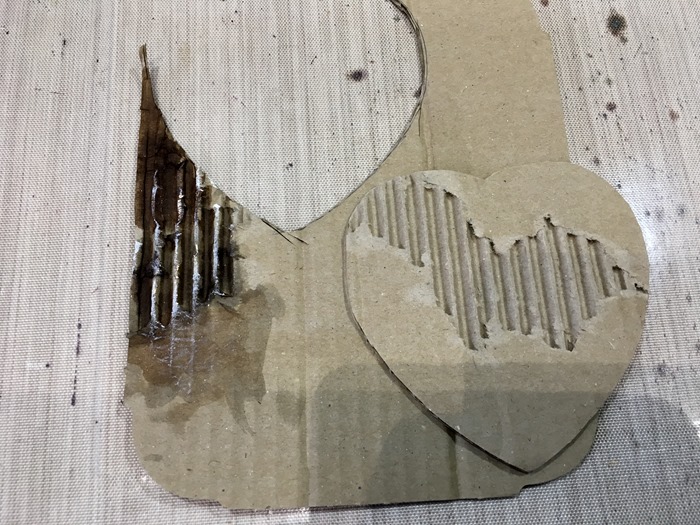
I began by using the original back piece of the frame to trace the shape onto some corrugated cardboard to make the background of the altered heart.

01 Cutting the Corrugated Cardboard

I tore off some of the top layer of paper to expose the corrugations.

02 Tearing the Corrugated Cardboard

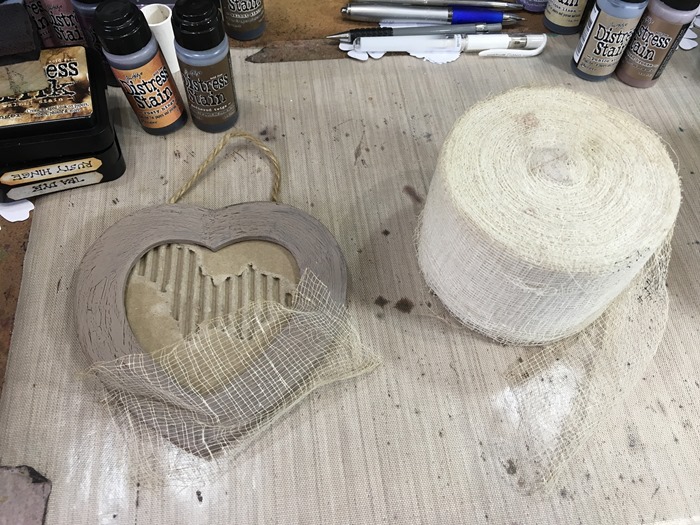
I rummaged through a lot of my mixed media supplies to find the right sort of mesh to overlay the bottom part, and eventually decided upon an old roll of scrim which I think was originally supposed to be used for plastering walls – I’ve had it for many years and can’t remember where it came from.

03 Choosing the Mesh

I cut off a length and stuck it down across the bottom of the frame, pulling it as tight as I could.

I then did a bit of experimenting with inks and paints to get the effect I wanted on the corrugated cardboard.

04 Testing the Corrugated Cardboard Painting

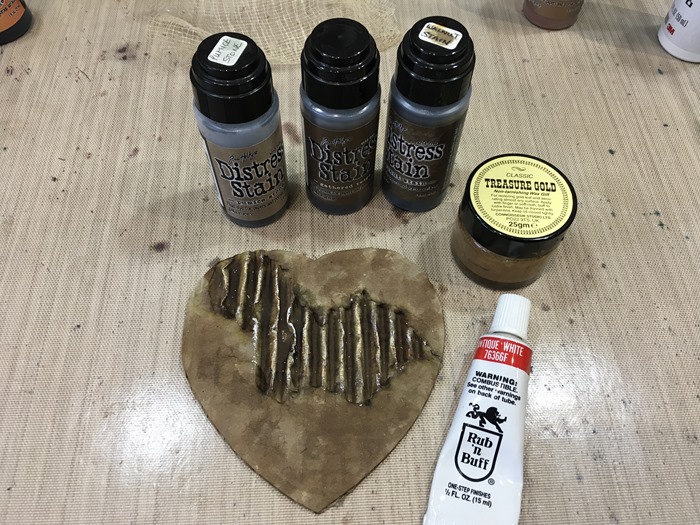
I used three shades of Distress Stains – Pumice Stone, Gathered Twigs and Walnut Stain, creating a mottled effect. When this was dry, I added a little Treasure Gold gilding wax and a touch of Antique White Rub’n Buff to highlight the corrugations. The gold doesn’t really show up very well on the photo.

05 Painting the Corrugated Cardboard

Here is the corrugated cardboard in place in the frame.

06 Corrugated Cardboard in Place

Turning it over to work on the back, I packed out the recess with more corrugated cardboard and secured it in place with masking tape.

07 Attaching the Packing in the Back

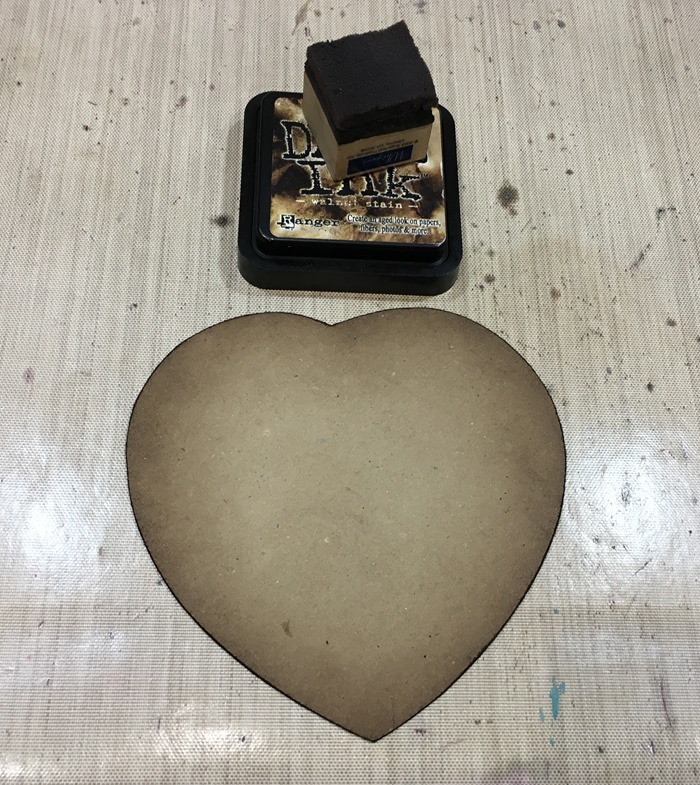
I used the outside of the heart frame to trace the piece of cardboard for the back, and distressed the edges with Walnut Stain Distress Ink.

09 Inking the Back Piece

I stuck this onto the back of the piece and signed and dated it.

10 Back Piece in Place

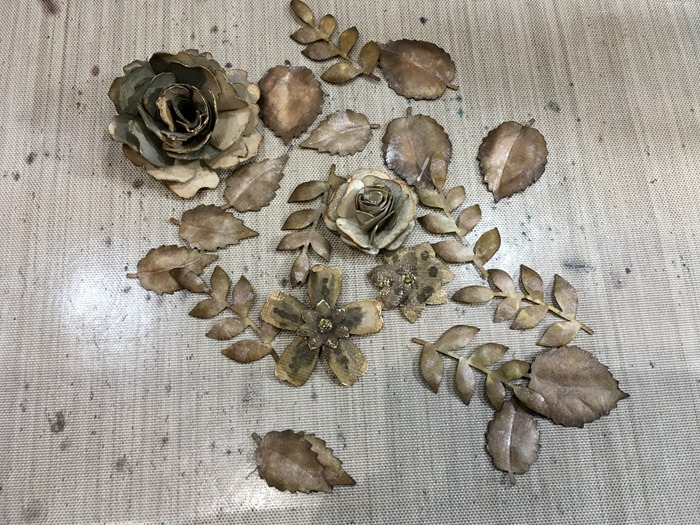
Here are all the brown roses and single-piece flowers that I made for the brown heart. They have also been highlighted with some Treasure Gold gilding wax.

40 All the Brown Flowers

The brown leaves, together with a few of the flowers, ready to be stuck to the front of the frame.

47 Brown Leaves with Some Flowers

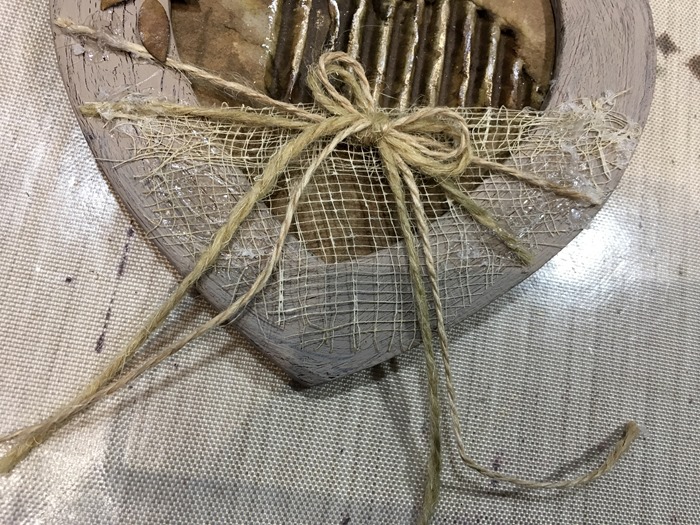
After sticking down the mesh, I added a couple of lengths of different thickness of jute string and tied them in a bow. The overhang of the mesh and the excess string was trimmed off flush with the edge of the frame.

08 Mesh and Jute String

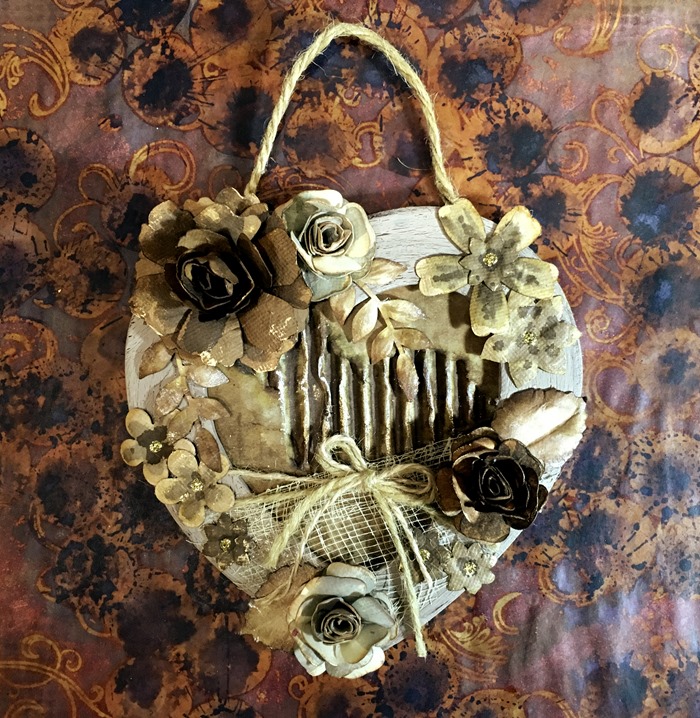
Time to add the flowers and leaves. Here is the finished result.

11 Brown Heart Complete

When she came over and I gave her the heart, she was intrigued by the various processes I’d used, and we had a short session up in my studio where I demonstrated first how the roses were constructed, and then showed her the gilding wax – she has achieved similar effects with dry brushing. It was very interesting comparing notes about how we have achieved similar results in other areas, by using different methods. She has only recently branched into mixed media art from more of a fine-art background and is exploring different materials. Quite an adventure and I am very excited about it, and can’t wait to see what else she is going to come up with! I was so pleased that I’d hit the right spot with her little heart, with the colour she would have chosen, and the different materials and textures.

Monday, 26 November 2018

Brown Flowers for the Altering Project

Third and final colour scheme – naturals and browns.

For the lighter coloured roses, I began by painting the flower pieces with Antique Linen Distress Stain. I discovered the quickest way of doing this was to prise off the dauber top from the bottle with a knife and just dip the brush in. Too much faffing around daubing it onto the craft sheet or onto the flower pieces which tend to rip if you rub them when they are wet. I really hate the dauber tops on the Distress Stains!

33 Small Roses with Antique Linen

Half way through this, I managed to tip the bottle over… I managed to scoop most of it up with a palette knife and then used the flower pieces to smoosh up the rest. I decided that I was too clumsy to be trusted with open bottles of Distress Stains on the desk, so from now on, I am standing the open bottle in a plastic bowl in case of accidents! A simple matter to pour it back into the bottle if I knock it over.

The other day online I saw some flowers with petals that were half-and-half in two colours and the effect was lovely, so I thought I would try this. The second colour was Pumice Stone. I painted this on fairly roughly as before.

34 Small Roses with Pumice Stone

Here is the set of light brown roses with the half-and-half petals. I am really pleased with this effect.

35 Light Brown Roses

36 Light Brown Roses Close Up

The other thing I discovered, doing these, was that it was quicker to distress the edges of the petals once the flowers were assembled. I discovered this because I made up the small roses and then realised I hadn’t done it. The result is just as effective, and done in less than half the time – a quick swipe back and forth over the flower with the blending tool and it’s done. For this I used Tea Dye Distress Ink.

Moving on to the darker brown flowers, here are the cut out pieces for two sizes of roses and some single-piece flowers. I used Gathered Twigs and Tea Dye Distress Stains for these.

37 Dark Brown Flower Pieces

The roses complete. They needed a little something extra so I lightly rubbed a little gold gilding wax over the petal tips and they positively shimmer! As usual, the photos don’t do them justice.

38 Dark Brown Roses Complete

39 Dark Brown Roses Close Up

All the brown flowers. I’ve added a little gold gilding wax to all of them, and I layered some of the single-piece flowers.

40 All the Brown Flowers

The final touch was to add a tiny dot of gold Stickles to the centre of these flowers.

41 Single Piece Dark Brown Flowers with Stickles

I’m not sure there’s much more I can show you on this project for a little while, apart from making a few single-piece turquoise flowers, but keep watching this space – I shall be working away in the background to get things finished.

Thursday, 21 June 2018

Card and Present for a Centenarian

On Saturday we are going to a party to celebrate a friend’s 100th birthday. She is a truly remarkable lady and you’d never guess she was this old! She gets out and about and joins in everything, and is a real character. I really wanted to make her something special for her birthday but didn’t have much time to do it, so this week I’ve pulled out all the stops and really cracked on, and at last I’ve finished, bar a few finishing touches.

The Card

In February I went to the Craft4Crafters craft show in Exeter, and bought some lovely dies by Die’sire (Crafters’ Companion) – these are supposed to be to create easel cards but I thought this lady might not know how to work them, so I decided on doing a straightforward card for her, using most of the elements. I chose the gorgeous butterfly card set.

Here is the topper in the early stages. I forgot to photograph every stage, but I chose some paper and card from a wonderful collection that a friend gave me for my birthday – she was so delighted that I was already starting to use them. The base layer is a dull gold card with bright gold text, “Congratulations” all over it. I chose a piece of green and white floral card for the next mat layer, and on top of this, a decorative paper with pink roses on a green and white background. These two mat layers were cut with the two frame dies from the set, and I distressed the edges of the top layer with distress inks and a bit of water spattering.

Here’s a more detailed shot. Originally I was going to use one or both of the wide ribbons in the previous photo but on further consideration, thought they were a bit too wide, so I chose a narrow pink organza ribbon, and a slightly narrower green satin one with a picot edge instead. I also selected a few flowers left over from the Floral Mini-Album project, which would tone in nicely with this card.

I selected some sentiment pieces from my stash, which I had cut some time ago on Sheba, my Cougar cutting machine. I coloured the text pieces with Worn Lipstick Distress Stain, and the shadow pieces I first coloured with Dried Marigold Distress Stain to give a nice rich base colour, and then added Treasure Gold gilding wax.

I layered the pieces, sticking them together with spray adhesive. Behind, you can see my home made spraying booth.

Turning to the inside of the card, I coloured it very lightly, using Inkylicious Ink Dusters and Distress Inks, first working in from the edge with Evergreen Bough, and then covering the whole of the middle with Antique Linen. After this, I stamped a selection of butterflies with Versamark and heat-embossed them with clear embossing powder. I then continued to colour the paper, first with Old Paper Distress Ink, and then a little Spun Sugar, concentrating on the areas where the embossed butterflies were. I rubbed these with very slightly damp kitchen paper to remove any ink from the embossing, and added some water spatters which I allowed to sit for a minute or two before blotting them off. The final touch was to add a bit more distressing around the edges, this time with Bundled Sage Distress Ink and a home-made ink blender.

The result is quite subtle, I think, and the embossed butterflies echo the theme of the card.

Here is a mock-up of the front of the card with all the elements laid in place.

The two little leaves were from my stash. Every now and then I cut a whole sheet of different elements on Sheba, from white card, and store them away, ready for when I need them, and I can colour them individually according to the project. This time I used Bundled Sage Distress Stain.

To add a bit of interest, I daubed a little Forest Moss Distress Stain onto my craft sheet and with a very fine wet brush, added a deeper colour to pick out the veins of the leaves. I spritzed them lightly with water and blotted them to soften the effect a little, and then dried the leaves with my heat gun. They were stuck down with Scotch Quick Dry adhesive.

Here is the finished card with the final elements added. I left it out overnight to allow the glue etc. to dry.

Before attaching the topper to the base, I attached the two layers of ribbon, fixing them on the back of the gold “Congratulations” card with double sided tape, and attaching a small piece of each, folded over to form two tails, with glue dots. The top of this was covered with the paper flowers, which were attached with hot glue. The leaves were stuck down with Scotch Quick Dry Adhesive.

The butterflies in the die set all have the ability to have their wings folded upwards, and whenever I do this, I always add a blob of Pinflair glue gel under each wing to keep them up and stop them getting flattened. This glue dries crystal clear and you really don’t see it. It also doesn’t lose any dimension as it dries, making it ideal for uses such as this. It is a very three-dimensional glue.

I added a few dots of Holly Stickles down the bodies of the butterflies, and in the centre of the smaller pink flower. Both the Pinflair and the Stickles glitter glue need time to dry before they can be handled. Unfortunately the Stickles dry a lot flatter than they appear when first applied, which I think is a shame because I love the 3-D effect you get with them when they are wet.

I stuck down the sentiment on the front of the card and inside, using Scotch Quick Dry Adhesive.

Now all that remains is to cover a box that I’ve got, which will serve as an envelope – the whole thing is rather thick, with the roses and the raised butterflies’ wings.

The Present

A small cross-stitch plaque with the word “Shalom” in Hebrew and English letters. The tall stroke of the Hebrew letter “lamed” extends to become the English “L”. I worked this cross-stitch with two strands of stranded cotton on 22-count Aida fabric, working in the small clip-frame which has a hanger on the top.

Beside it you can see the original one which I made for myself.

When this photo had been taken, I had completed the cross stitch but had not yet done the outlining back stitch in black, using a single strand of stranded cotton. This really helps the design stand out against the background, as you will see if you compare the two plaques.

I created the original design on a programme called EasyCross, several years ago. Unfortunately this software does not work fully with Windows 10. I was able to print out the design (top right in the above photo) but the colours weren’t right, and it was covered with very distracting diagonal dotted lines. I ended up colouring the background with coloured pencils to show me where to change. Before I did this, I found I was making numerous mistakes, and the bottom half of the design had to be fudged a bit but it’s worked out OK. The graduations between the rainbow colours were achieved by mixing threads on the needle – one strand of each colour. In the original, I worked alternate stitches of each colour for the transition, and I can’t decide which I prefer.

I have bought a new cross-stitch designing programme called WinStitch (there is also an Apple version called MacStitch). Unfortunately the old EasyCross files won’t open in this programme but at least I can print out my original designs and copy them into the new programme. This will take a long time but it will be nice to have them available again. I haven’t done any of this for such a long time and now feel I want to take it up again, and I was very pleased to find that an alternative programme exists to replace the now defunct EasyCross. A shame this programme has been discontinued because it was very good indeed.

Here is the completed plaque.

This is the reverse.

To finish off the back, I trimmed back the edges of the embroidery fabric and glued it to the inner ring of the frame with tacky glue, leaving it to dry for a while, held in place by a series of plastic clamps that I’ve got.

I stuck some cream polycotton fabric onto a piece of self-adhesive pelmet Vylene and used the inner ring of the frame as a template to make a paper pattern to cut it out. Unfortunately I had to cut this by hand and it’s a bit shaky round the edges! I think what I need to do is to scan the inner ring, and use this image to create a template in Inkscape, which I can cut on the cutting machine, which would give a much neater result.

To neaten it a bit, I ran some tacky glue around the junction between the two frames and stuck on some gold Lurex crochet thread, finishing it off with a small bow that I made on my bow maker. This was stuck down with a tiny blob of Pinflair gel adhesive, and again, this was left to dry overnight. I have also signed the back and dated it.

I am busy tomorrow morning, but I have every hope that I shall finish off this whole project in the afternoon, and get it wrapped ready for the birthday party the following day.

Thursday, 24 May 2018

Wood Effect Anniversary Card

Today is our 32nd wedding anniversary. Where did the years go?

Having been so ill recently, I only managed to give my hubby a bought card for his birthday, and that was bought for me by a friend! I thought I’d better push the boat out a bit and make an effort and make a nice card for him for our anniversary.

At the County Show last Friday I was fascinated by a little wooden tag attached to the most expensive chopping board (if it hadn’t been for the price I’d have bought it because I fell in love with it!) – the little tag was made of laser cut veneer, and as soon as I saw it, I knew I could make something similar in card, and this would be the basis for my hubby’s card.

I began in Inkscape, working on my Apple Mac which is connected to the Cougar cutting machine (called Sheba). I found a free svg file online of nesting hearts, and I cut a dozen heart-shaped frames using two of the nesting sizes – unfortunately I forgot to photograph these till it was too late, but this is the paper left after they had been cut out. I ended up with a dozen smaller hearts (the bits that fell out of the frames) and most of these will go in my stash for other projects. In this photo you can also see the A4 piece with a window cut out for the front of the card.

I seem to end up using American Cardstock card for most of my cutting projects because it cuts like a dream. However, it’s not quite robust enough for a card base with lots of embellishments so this would have to be reinforced later on.

Again, I kept forgetting to photograph my progress. For the front and back of the tag I cut two hearts the same size as the outside of the frame, and these pieces also had our initials cut in them, as well as some little geometric flower petals like on the tag at the show. Propped up against the paint pot, you can see the completed frame, and the thickness I was able to achieve by laminating several layers of card together. When the edges were painted they looked like a bit of plywood! See below for the painting technique to replicate woodgrain.

The initials on the right were the pieces that fell out when I cut them from the hearts, and would be used to embellish the inside of the card.

I had intended to leave the initials in the hearts hollow as well as the petals, but you could see through and the one on the reverse was confusing, so to overcome this problem I stuck a small square of gold card on the back of each piece, so that the initials were gold, and opaque.

I glued the frame pieces stacked together to give a laminated and more rigid frame for the embellishment. In this picture you can see the linen carpet thread I used to suspend the embellishment, and the two heart pieces (front and back) ready to be attached to the frame.

Here is the first piece attached to the frame, with it’s little square of gold card glued on, to make the initial solid, and the hanging thread.

Here is the finished tag, with the side with my hubby’s initial on the left, and mine on the right.

I am so pleased with this little heart embellishment – it reminds me of some olive wood Christmas tree decorations I’ve got. I think one could take this idea further and make them in different shapes. They have a Scandinavian or Eastern European feel to them. I’ve wanted to make something like this for ages and thought of using mounting board but this is too thick to cut with Sheba, and you couldn’t cut them by hand. The laminated frame idea works well, or one could just laminate solid shapes. You could still have a design pierced through. They might make nice little Christmas gifts, or perhaps wedding favours.

Moving on to the card base, I painted the whole of the front with beige fluid acrylic, and then with Desert Sands Infusions, taking care to paint broad vertical strips to represent the wood grain, as I did on the heart pieces.

Turning to the inside, I created another type of woodgrain background, this time with Distress Stains, to make a lighter background as a contrast. Normally I don’t much like the unevenness you get with these (the dauber bottle isn’t my favourite form of delivery) but for woodgrain the effect is ideal. I used a combination of Antique Linen and Old Paper. This is the technique I used for one of the pages in my Floral Mini Album.

Here is the main card base, and the piece I cut and coloured with Distress Stains to be stuck on the back of the card front. The hanging string would be sandwiched between these two layers. You can also see the two thin circles I cut from gold card, to frame the hole, both front and back, to give a nice finish to the card.

Here are all the materials I used to create the embellishments inside the card. I used a couple of the hearts cut from the middles of the frame pieces, and coloured them to look like wood, as for the front of the card, but this time, to add a bit of bling, I also added a light touch of Treasure Gold (gilding wax). For the sentiments I simply used some peel-offs that I’ve had in my stash for years. They were very small, but I like the effect of the gold on the woodgrain, and I didn’t want anything competing with the rest of the design.

The edges of the hearts were distressed, and they were glued together and stuck down, and some shading added. The initials were what was cut out of the front and back of the embellishment. I daubed them with Antique Linen and Old Paper Distress stains, and they also had a light dusting of Treasure Gold.

I cut a piece of plain white card and stuck it to the back of the card base for extra rigidity. Even though it was just the back, I distressed the edges with Gathered Twigs Distress Ink to take away the starkness of the white card.

Here is the finished card lying flat.

Here it is standing, so that you can see how the embellishment turns and moves as it hangs freely in the aperture of the card.

The completed inside of the card. You can see the embellishment through the aperture of the card.

I think this faux wood effect has come out very well. When I  have used Infusions in this way before (see this post for an example), I used Desert Sands Infusions straight onto white card, and it came out very orange – not a problem if you want it that way, but I wanted a more subtle approach here, so I used the Infusions on a painted substrate. You could make faux woodgrain in this way with any colour you wanted really.

Another reason I like this effect is that it is very suitable for a card for a man. It is strong and more sombre but it also has a natural effect. I used a similar theme on my hubby’s anniversary card in 2016, but this time with a woodgrain effect created with an embossing folder.

I seem to be in a bit of a brown phase again at the moment, after the bright colours of the Floral Mini-Album! I can’t wait to try replicating the effect of the absolutely fabulous wooden moths I saw at the County Show…

Related Posts Plugin for WordPress, Blogger...