Showing posts with label svg files. Show all posts

Thursday, 22 November 2018

An Altering Project

There are a few things I need to make over the next few weeks, so it’s studio time again. I can’t reveal too much detail yet, but later I will be able to tell you more. In the meantime, I can safely share the early stages without giving away too much.

Recently my hubby bought four small frames and then realised they didn’t have any glass, which he didn’t like, so he gave them to me, and I thought they would be lovely to alter.

01 Four Small Frames for Altering

I took them apart and pulled off all the embellishments for use elsewhere. Each frame had a tiny clothes peg with a message attached, and the whole thing tied onto the frame with some gorgeous jute string which is definitely going in my stash! The shiny card can also be used for something else. Not much gets thrown out chez Shosh.

02 Frames Taken Apart

The next step, when I get time, will be to paint the frames with gesso in readiness for altering.

I am awaiting the arrival of some supplies for this project from Ebay, and can’t make real progress till they arrive. I also have several wallpaper sample sheets,  and I have decided to use one or more in the project.

03 Selection of Wallpapers

The patterns are quite large, but there are some lovely bits I can cut out, and some nice texture for backgrounds, and the colours are gorgeous. I decided to make lots of paper flowers, mostly roses, and to try and match up the colour to co-ordinate with the wallpapers.

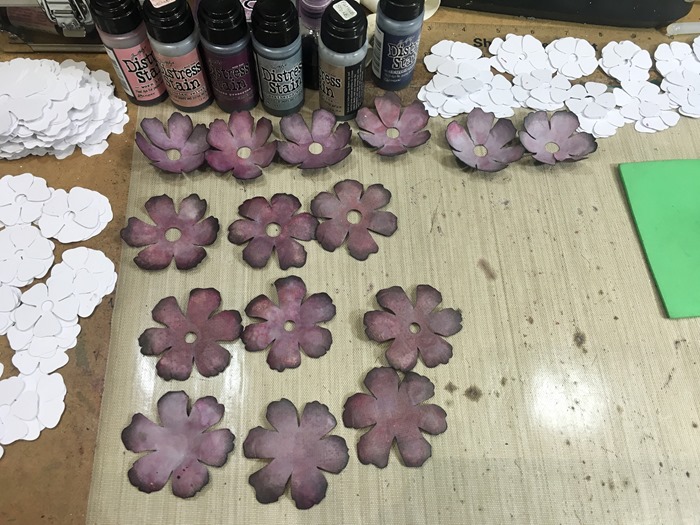
I spent a long time cutting several 12 x 12 sheets of flower pieces on Sheba, my Cougar cutting machine, using American Crafts Cardstock in white, which cuts beautifully with Sheba, and although less strong than watercolour paper, is strong enough not to disintegrate when wet, and thinner too, which is ideal for the flowers that I make. Here they are, all laid out ready for colouring. The pieces in the bowls are individual flowers, and the others on the desk, stacked up in piles, are the pieces necessary to make individual roses in two sizes and styles. All these flower patterns are svg files from Penny Duncan, and I use them regularly – easy to resize as necessary in Inkscape, and then cut out.

01 Flower Pieces Cut

For this flower factory, I began with the roses. I selected a variety of different colours from my collection of Distress Stains. The idea was to produce a nice subtle mix of colours to co-ordinate with the wallpapers, and I knew it would take several layers.

I began with Worn Lipstick, smearing some on my non-stick craft sheet and spritzing it with a bit of water, and roughly painting both sides of the required number of flower pieces to make some roses.
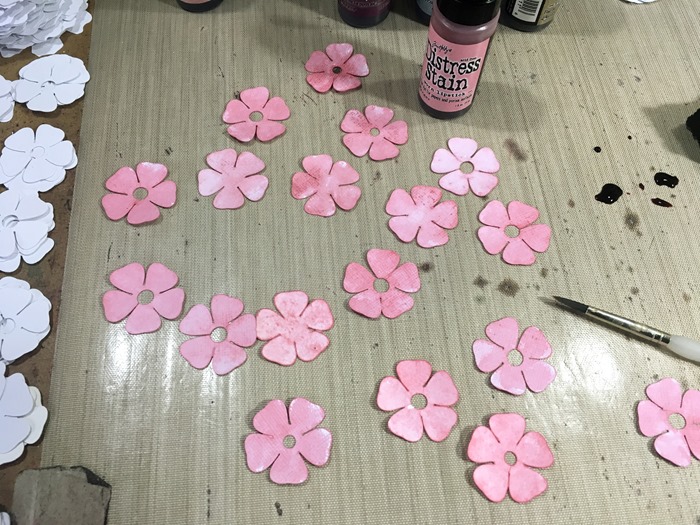
02 Colouring Small Roses 1 - Worn Lipstick

The next colour I chose was Victorian Velvet.
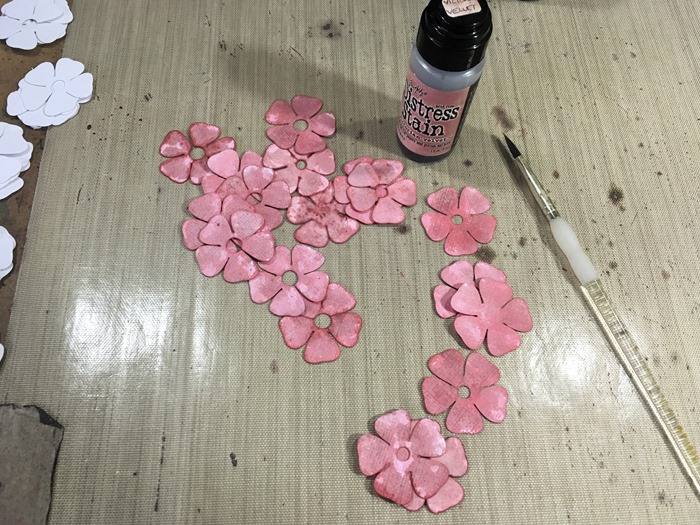
03 Colouring Small Roses 2 - Victorian Velvet

After this was Seedless Preserves.

04 Colouring Small Roses 3 - Seedless Preserves

You can see how the colour is darkening, and with subtle variations. It was all looking a bit pink, so the next colour I chose was Weathered Wood, which is a lovely slate-blue colour verging on grey, which I thought would make them more purple and dull the colour down a bit.
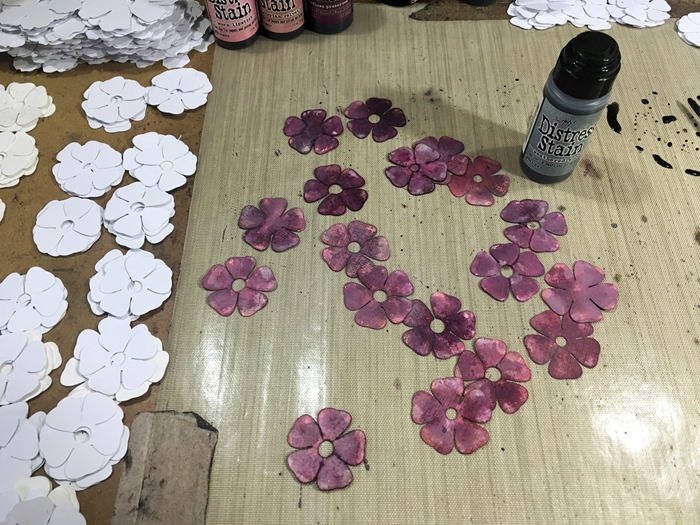
05 Colouring Small Roses 4 - Weathered Wood

It needed more of a brown look, so I chose Pumice Stone, which is a very useful colour in the Distress range – added to any colour, it has the effect of dulling it down.

06 Colouring Small Roses 5 - Pumice Stone

It still needed to be duller, and more grey, so the final colour I chose was Hickory Smoke. I do not have this colour in my Distress Stains collection, so I smeared the Distress Ink pad on my craft sheet, spritzed it with water, and used that instead.
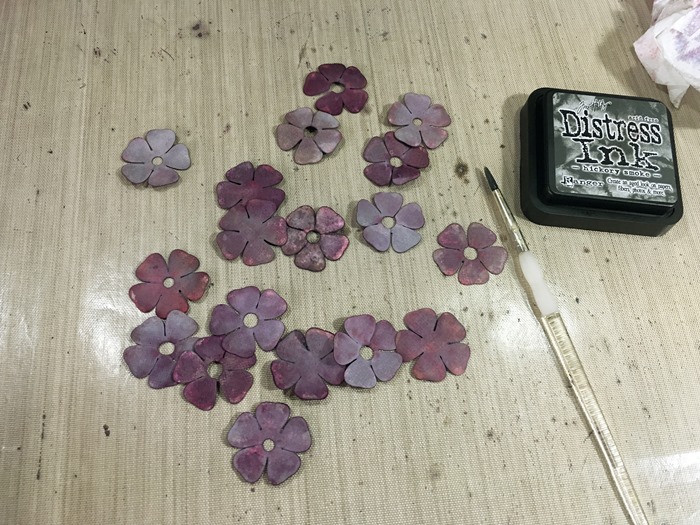
08 Colouring Small Roses 7 - Hickory Smoke

This was the effect I was looking for. At each stage, I dried the flower pieces with my heat gun, before proceeding to the next colour. When the pieces are wet, they are very fragile, especially the ones with the slit. The final step was to distress the edges with Hickory Smoke Distress Ink, using a home-made ink blender.

09 Distressing Edges of Small Roses - Hickory Smoke

Once they were fully dry after the final colour, I hand-embossed each petal, some cups and some domes after deciding which side of the piece should be on top, according to their eventual position in the rose.

10 Hand-Embossing Small Roses

The first of the small dark roses completed. Each layer is stuck with hot glue.

11 Dark Small Roses Complete

Time to move on to the larger, shabby roses – what Penny Duncan calls her “Grungey Rose” pattern. These have more interesting tips to their petals, and the roses are more open and natural looking. Each flower requires the same number of pieces, and the method of construction is the same. Here are the pieces in the middle of being coloured, using the same succession of colours that I used before.
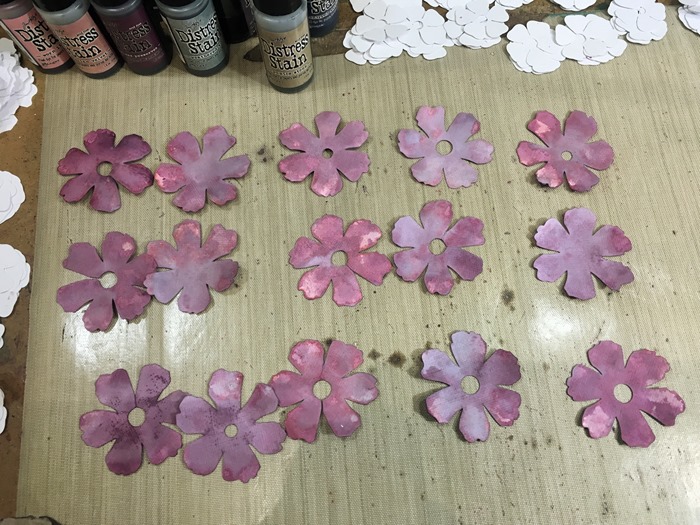
12 Colouring Shabby Roses

The pieces after embossing.

13 Shabby Rose Pieces Embossed

Here are the three dark-coloured shabby roses that I made.

14 Dark Shabby Roses Complete

Having documented the colours I used and how I coloured the pieces, I can refer back to this post and repeat the process, should I need some more.

Both sizes of rose together.

15 Shabby and Small Dark Roses Complete

I really like this subtle, dark and dusky purple – actually not purple but a mixture of colours to give interest and depth. Laid on top of a couple of the the wallpaper samples, they are a pretty good match, I think.

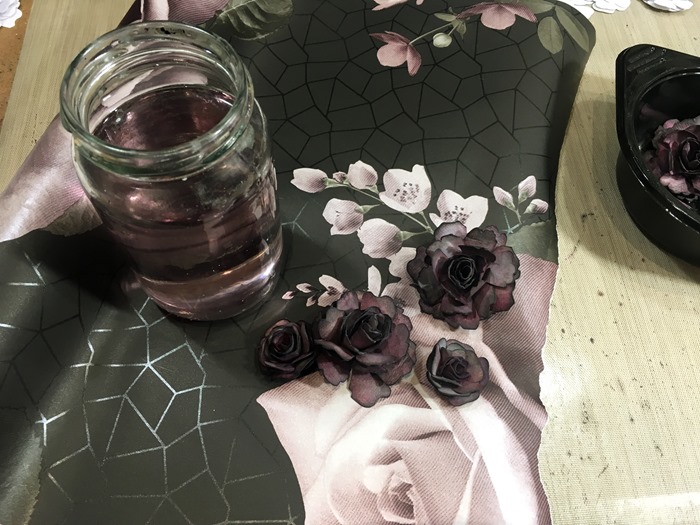
16 Dark Roses on Light Rose Wallpaper

17 Dark Roses on Dark Rose Wallpaper

I shan’t know how many of these roses I shall need until my supplies arrive from Ebay, but that shouldn’t take more than a few days.  At least I’ve been able to get ahead a bit. Watch this space!

Saturday, 8 December 2012

Birthday Card for Gisele

Today is my friend Gisele’s birthday, and rather than choosing one of the (so far very few!) cards from the Card Factory, which she may well have seen as she follows my blog, I made her a card today from scratch.

I used a couple of die-cuts from the marvellous pack that I recently received from Judy in Australia. I added a little distressing to both circles, and hand-embossed around the edge of the smaller one which has some music on it.

The pink flower was made from some die-cut pieces which I also hand-embossed, and assembled with Pinflair gel glue, and decorated with Flowersoft and Stickles, and the leaves were some ready-made rose leaves from my stash.

I cut the swirls and the sentiment using Sheba, my Black Cat cutter (see my sidebar for details of this machine). The swirls were from a cut file of Penny Duncan, and the sentiment was my own design using Edwardian Script font. (This file is on my SkyDrive, available for free download.) The sentiments were cut from a shade of green which echoed the leaves. All these items were cut from American Crafts cardstock which cuts beautifully on my machine. The swirls were darkened with Vintage Photo Distress Ink before being stuck down onto the die-cuts, and the flower added on top.

The decorative paper was part of a stack I bought when I first started, from Ebay. I haven’t used a great deal of it because as time has gone on, I haven’t liked it much. This particular sheet had been toned down with Picket Fence Distress Stain some time ago when I was working on another project, and seemed to be right for this pink-themed card.

The card base was plain heavy white cardstock that I’d bought at a craft fair some time ago, distressed around the edges with Worn Lipstick Distress Ink.

Inside I distressed the edges with Spun Sugar Distress Ink and added a music background stamp using Old Paper Distress Ink, and a Happy Birthday sentiment using Festive Berries Distress Ink. We both signed the card using a pink glitter gel pen.

All very pink and girly!!

Off to a party tonight to celebrate her birthday.

Wednesday, 28 November 2012

WOYWW 182–Tattered Time Album

Well, it’s Snoopy Time again! Time to snoop around each other’s work desks and see what we’ve all been up to this week. The lovely Julia of Stamping Ground (see the WOYWW link in my sidebar) does her best to keep us unruly mob in order as we open our inner creative sanctums (or should that be sancta?) to the glare of worldwide publicity, warts and all.

This week I started an exciting new project to join the ranks of my UFOs (Un-Finished Objects) – all of which are progressing slowly together in parallel! It’s a mini album (actually not so mini) made from paper bags and using the DCWV Tattered Time paper stack. I bought this over a year ago and since then it’s lived on the shelf, only to be taken down every now and then to be stroked because it is… Gorrrrrgeous.

This is what I’ve done so far on Page 1.

It’s in honour of my Dad, and the first page is about his ancestors – my great-grandparents and grandparents. For full details and to see some better pictures, please see my most recent blog posts.

Yes, I know… I should be working on the Card Factory. Trouble is, I’d MUCH rather be doing this.

I’ve also started designing some tags in Inkscape, ready for cutting with Sheba, my Black Cat Cougar cutting machine (see my sidebar for details of this machine). Here’s a screen shot of my first one – a work in progress – a tag with a decorative top, and a matching pouch. I shall also be designing some for the mini-album, and svg cut files and pdfs will eventually make their way onto my Skydrive for free download for whoever wants to use them.

Have a very happy and creative WOYWW, everybody. Not sure if I’ll do any better this week than last week at visiting desks, but we shall see!

Sunday, 18 November 2012

The Annual Card Factory Begins–Judy’s Topper

It’s that time of year again… and no, I don’t mean the dreaded “C” word! It’s time to replenish the card stash, and also to make up a set of birthday cards for a Christmas present for my mum. As she’s got older, she’s wanted to downsize, and really doesn’t appreciate a lot of “stuff” as presents, and it’s become quite hard to think of things to get her. Last year she asked if I would make cards for her to send to family and friends, and at first I balked at the idea, as I am really trying to move away from card making these days, but then I thought, “If that’s what she wants, what a good Christmas present it would make!” You know what they say – you only have to do something once for it to become a tradition! So out comes the card making stuff again, and I’ve made a start.

I also need to make cards to send to family and friends myself, and because most of our family have their birthdays in the first few months of the year, I need to get ready. I am also planning on making a lot of generic-type cards that I can put different greetings and sentiments on, so that I’ve always got something ready in an emergency, and a collection of different toppers so I can assemble something quickly. There are always thank you cards to do; people always appreciate a hand-made card after they’ve invited you out, for instance.

I so appreciate Judy, Julia and other friends who have sent me packets of die cuts over the past few months! These are coming in handy as I start to make toppers and card bases.

My first card  in the factory (A4 folded to A5 size) has utilised Judy’s wonderful card topper that she put in with her die cuts. Although it is quite thick, each layer is stuck down with a foam pad so it squashes fairly flat, and there’s nothing to get damaged in the post. I’ve just matted it onto some dark red card (from Paper Mill Direct), and the card base is heavy white cardstock which has been inked with Victorian Velvet Distress Ink and then spattered with water, blotted and dried with the heat gun. (I love this technique! Instant gorgeous background!)

Every now and then I cut a whole sheet of “Happy Birthday” or “Thank You” etc. greetings on Sheba, my Black Cat Cougar cutting machine. I’ve got various files (svgs) of these sheets saved, so that I just open them up, bung the card in and start cutting! (I’ve also done this for flowers that I use a lot.) Each greeting file includes an equal number of matching shadow (mat) layers for the particular greeting, and cutting them all from plain white cardstock or watercolour paper, I can then quickly colour them with Distress Stains to co-ordinate with my project. For this card, I used Bundled Sage for the actual text, and Forest Moss for the shadow layer. After I had stuck them together with Scotch Quick Dry Adhesive, I stuck them down onto the card using the same glue, and then carefully separated the letters with a matching marker.

Inside, I partially inked a background text stamp (“Calligraphic Mat #4” from the Artistic Stamper) with Old Paper Distress Ink so that it ended up with an irregular outline, and then stamped Happy Birthday (“Happy Birthday” from The Stamp Barn) with a dark red ink pad (“Pretty Colour” Pigment Stamp Pad #30). The edges of the inside are distressed with Spun Sugar Distress Ink just to soften the white a little.

I’m very pleased with how this one came out! Thanks Judy for a great topper.

Sunday, 11 November 2012

Poppies for Remembrance–Tutorial

I am creating a page in my new art journal entitled “Remembrance” as it is Remembrance Sunday. I am embellishing it with some paper poppies which I have made, and to prevent the blog post on the art journal page being too long, I have decided to post separately about the construction of the poppies.

I designed the poppies and leaves in Inkscape. This is a bitmap image of the svg file which is available for free download from my OneDrive, if you would like to download it and use it on your cutting machine, or alternatively, print out the image at whatever size you want, and use it as a template. I cut two sizes of the poppy and leaf pieces.

01 Poppy and Leaves Cut File

I cut the shapes using Sheba, my Cougar cutting machine – you can read about this machine in my sidebar. The two poppy shapes are designed to be laid one on top of the other, at right angles to one another, to create a 3-D flower once the petals are embossed.

Cutting the leaf pieces from green cardstock:

02 Cutting the Leaves

Cutting the poppy pieces from red cardstock:

03 Cutting the Poppies

Unfortunately I didn’t get very satisfactory cuts, but then I have been reliably informed on the Thyme Machines forum (the forum for my cutting machine) that card from that particular supplier doesn’t cut very well! I got there in the end, though, even if some of the pieces needed a bit of trimming with fine scissors afterwards. Here are the pieces cut. I have made far more than I need for this project, so that I can make up some poppies to go in my stash.

04 Poppy and Leaf Pieces Cut

The next step was to shade them, and I did this with Distress Inks acting as watercolours, with a fine brush. Inking the leaves, using Forest Moss Distress Ink. I rubbed the ink pad onto my non-stick craft sheet and picked it up with the wet brush.

05 Inking the Leaves

For the poppies I used Festive Berries Distress Ink.

06 Inking the Poppies

I thought they needed to be a bit darker and more defined in the centre, so I added some Shaded Lilac Distress Ink to give them more dimension.

07 Inking the Poppies

Here are all the pieces with the inking completed, ready for embossing.

08 Inking Completed

Each piece was hand-embossed onto a piece of fun foam. Embossing the leaves from behind, so that they would be slightly convex when assembled:

09 Embossing the Leaves

Embossing the poppies, this time from the front, to make the petals cup-shaped. This time I used a larger embossing tool.

10 Embossing the Poppies

All the pieces embossed:

11 All the Pieces Embossed

They were then assembled using Scotch Quick-Dry Adhesive – I would have preferred to have used hot glue but my new cordless glue gun was taking too long to charge. I applied a dab of glue to the centre of one piece, and gently pressed the second one in place, at right angles to it, forming the poppy. This glue is recommended for making boxes, so I think it will be strong enough.

12 Petals Assembled

I glued some leaves onto the back.

13 Attaching the Leaves

To make the centres, I drew some circles of two different sizes onto a piece of scrap card, and filled each circle with a good blob of Pinflair gel glue.

14 Beginning the Centres

15 Circles of Pinflair Glue

Then I stuck flowersoft all over them and dried them with my heat gun.

16 Adding the Flowersoft

Unfortunately they don’t do black flowersoft (or at least, I haven’t got any!) so I used the darkest colour I had. Once the glue was dry, I simply painted them with black acrylic paint and cut them out. I finished them by running a black marker pen around the edges to cover the last of the pink.

17 Painting with Black Acrylic

18 Cutting Out the Centres

Then all I had to do was stick them into the centres of the poppies, again using Scotch Quick Dry Adhesive.

19 The Completed Poppies

In this photo, you can see little spots of white where the glue is showing; this was still wet, but once it was dry, it was colourless and invisible. Here is a detail photo of some of the poppies.

20 Detail of Poppies

I shall soon be uploading a post about the Remembrance page in my art journal, now that it is completed. Watch this space!

Art Journal Page–Remembrance

My latest art journal page is for Remembrance Day. It seems unbelievable that we are only two years from the centenary of the beginning of the First World War; I remember seeing on TV a few years ago, a programme entitled “The Last Tommy,” about the very last survivor of that terrible conflict, which was supposed to be “The War to end all wars…” The veterans of World War Two are now becoming very elderly, and soon that war will pass from living memory, too.

The conflicts go on, of course. At this time of year we remember not only those who died in the two World Wars, but also all of our armed forces fighting around the world, especially at present in Afghanistan. Our nephew returned home from there just a couple of weeks ago, and we are very glad to have him back, safe and sound, but this is not the case for far too many. Our hearts go out to the families of those who will never return, and for those whose lives are forever changed because of devastating injury.

Last year I designed a new service sheet for Remembrance Sunday for our church:

Remembrance Sunday Service Booklet

I have based my journal page loosely on this design.

When I did my Tyger Tyger page, I was disappointed at first that some of the green ink had bled through to the next page, but on balance I was glad, because it formed the basis for the left-hand page of my Remembrance layout.

Here is the page with the background text mapped out in pencil.

02 Background Text Pencilled In

These words were then filled in with brown water-based pens.

03 Background Text Completed with Pens

Here is a detail of this text.

04 Background Text Detail

I knew this would obviously be much too strong to be a background, so an acrylic glaze was required, to tone it right down. Before I could apply this, though, the water-based ink had to be sealed to prevent it running when the paint was applied. I recently acquired this spray sealant:

05 Spray Sealant

It seems to work very well, but the only problem is, it stinks. Big time! You are supposed to use it in a well-ventilated space, but it’s far too cold to open all the windows at the moment! I left my ARTHaven door open to get rid of it, and then the whole house stank of it. Ah well. One must suffer for one’s art…

Here is my pizza box spray booth, with scrap paper under the pages of the art journal that I’m working on, to protect what is underneath.

06 Sealing the Page Prior to Painting

Here are the materials for the acrylic glaze.

07 Materials for the Background Glaze

I used a mixture of brown and white acrylic paint, with some acrylic polymer to thin it to a glaze. This is what it is like mixed.

08 Mixing the Background Glaze

Here is the first layer of the glaze applied.

09 Painting and Blotting the Background Glaze

I painted it on, and blotted it off with kitchen paper several times, until I was happy with it. The text was still too obvious in the centre where I wanted to put a picture, so a lighter layer needed to be applied.

10 Background Glaze Almost Complete

11 Background Glaze Complete

You can see that the text is still visible, even through several layers, but it is much more subtle, and forms a varied and more interesting background than just leaving it plain. I dried this off with my heat gun. I did this for each stage of the project from now on – mixed media is great, but the most frustrating thing is waiting for each stage to dry before you can move on, so I bless the inventor of the heat gun!

Now I was ready for the interesting part: painting the details. First I painted some war graves and a Spitfire.

12 Spitfire and War Graves

I deliberately kept these fairly muted, but ultimately the gravestones were a little too muted and there wasn’t a lot I could do about that after I’d added the text.

13 Lest We Forget

To complete the right-hand page I painted a silhouette of a lone Tommy in a blighted landscape with some barbed wire. Again, I kept the palette muted, to suggest an old black and white photograph.

14 Centre Picture

Now came my first disaster! I wanted to splatter some red onto the foreground to represent the blood shed in the great world conflicts, and thought my best bet was Barn Door Distress re-inker. I should have remembered from the last page that what soaked through the page was Distress Ink! I spattered it on OK but it took an absolute age to dry, despite several sessions of blasting it with my heat gun, and it turned out quite translucent and not that bright – not the effect I was after. Worse still, when I turned back to my Tyger page, the wretched stuff had bled through, despite my having sprayed the Remembrance page with sealant!! All is not lost, though, because I think I can touch it up and cover up the red spots. Now I’ve managed to get a nice random spattered effect, I can go over the pale red spots with acrylic paint. (Looking back at the Tyger page subsequently, I think I’m going to leave the red spots because I find I’ve grown to like them!!)

I also managed to get a couple of somewhat linear spatters which I didn’t like, but these could be covered up with the barbed wire to be drawn in the foreground – these marks now determine the course of the barbed wire, which was going to be pretty random anyway. There aren’t usually mistakes with mixed media and art journals – merely challenges which can be covered over or incorporated into the ongoing design! However, from now on, I think I am going to miss alternate pages of this album so that any bleed-through won’t be a problem, and glue these blank pages together. (That way, I may actually be able to fill the book in my lifetime, too!)

In this picture, the darker spots are the ink which had not yet properly dried.

15 Red Ink Spatters

The next stage was to add the border. The famous words are “The Ode of Remembrance” from a poem by Laurence Binyon, entitled “For the Fallen,” first published in The Times in September 1914; it is read each Remembrance Sunday after the Last Post and the two-minute silence.

16 Border and Barbed Wire

The gaps in the text, and the space in the top left-hand corner, are where painted poppies would be inserted.

Here is a detailed shot of the journaling and the foreground barbed wire. I wrote it first with a red water-based marker, and then went round each letter with my size 08 permanent black marker that I use for zentangle drawing. These colours mirror the colour of the poppies and their centres.

17 Detail of Journaling and Barbed Wire

To complete the page, I cut some poppy shapes with Sheba, my Black Cat Cougar cutting machine (see my sidebar for details of this machine). To see how I made these flowers, please see my blog post here.I designed the poppies and leaves in Inkscape. This is a bitmap image of the svg file which is available for free download from my Skydrive. I cut two sizes of the poppy and leaf pieces.

01 Poppy and Leaves Cut File

I saved an image of the outline of the pieces as I wanted them to appear on the page, and printed this out. I cut it out and laid on the page to show where the various pieces would go.

18 Poppies Layout

19 Mock-Up of Poppy Layout

I drew some small poppies using water-based marker pens to fill the gaps in the text. The paper poppies, with their leaves, were then adhered in place on the page, according to the arrangement of the printed piece. This is the finished page.

20 Completed Page

Related Posts Plugin for WordPress, Blogger...